This post belongs to Atlantis Is Everywhere, a series exploring why the story of Atlantis has been repeatedly mapped onto real places around the world. Rather than arguing for or against any location, the series documents how each claim emerged, what evidence is cited, how it is interpreted, and where the research stands today.
Sardinia sits in the western Mediterranean, positioned between the Italian peninsula, North Africa, and the Iberian coast. It is large by Mediterranean standards, with varied topography that includes rugged uplands, mineral-rich interior zones, and long coastal plains. Unlike many smaller islands in the region, Sardinia is not marginal. It is strategically placed along maritime routes that connected eastern and western Mediterranean networks during the Bronze Age.
The island’s geography matters. It is large enough to sustain regional complexity. It is resource-rich, particularly in copper and lead. It is defensible. It is also visually marked by an architectural tradition unlike any other in the Mediterranean basin.
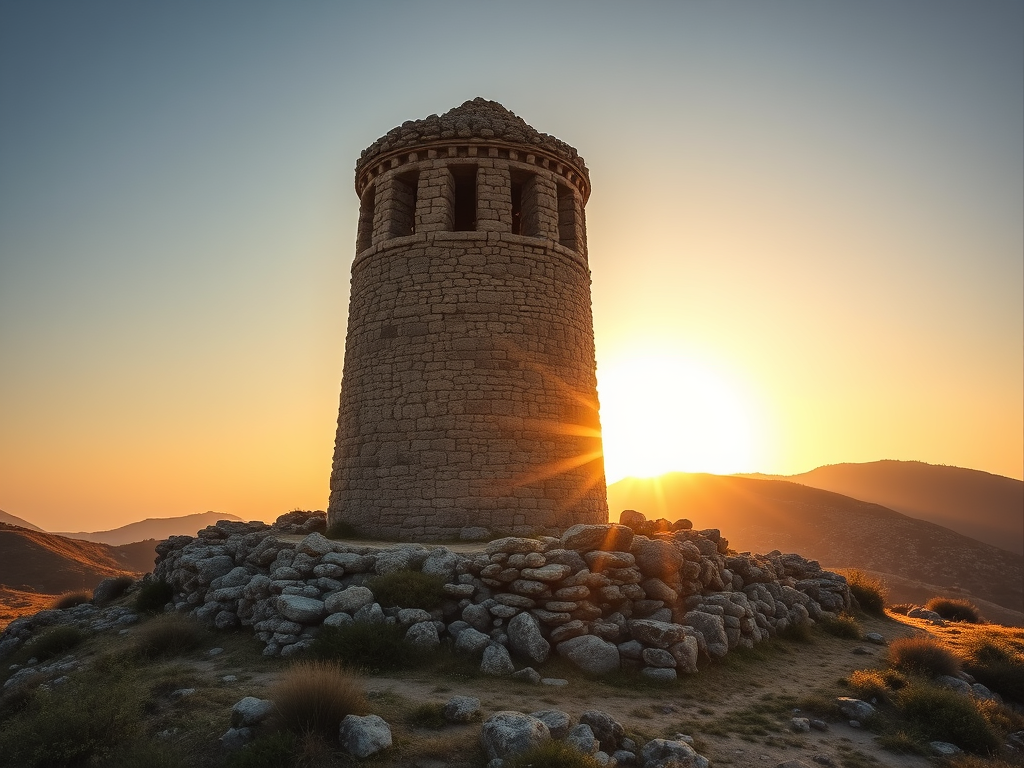
Across the island stand thousands of stone towers known as nuraghi. These structures, built from massive basalt blocks without mortar, date primarily from the second millennium BCE. Some are single towers. Others are elaborate complexes with central keeps, bastions, internal courtyards, staircases embedded within thick walls, and surrounding villages. Their density is striking. In some regions, they appear at intervals close enough to suggest deliberate territorial patterning.
Long before archaeology attempted systematic explanation, local traditions attributed these towers to earlier peoples, often described as giants or ancestral figures whose abilities exceeded those of later inhabitants. The structures were not treated as anonymous ruins. They were regarded as inheritances from a distant age whose builders no longer remained visible in memory.
Modern archaeology places the Nuragic civilization firmly within the Bronze Age. Excavations throughout the twentieth century, particularly under the direction of Giovanni Lilliu, established that the nuraghi were components of an organized and long-lived cultural system. Associated settlements, ritual wells, communal tombs known as “Giants’ Graves,” and sanctuaries reveal a society capable of coordinated labor, craft specialization, and sustained regional identity.
The architectural form itself warrants attention. The central towers employ corbelled vaulting and carefully fitted stone courses. Internal chambers were designed with structural understanding rather than improvisation. Some complexes evolved over centuries, with successive additions expanding defensive and symbolic presence. These were not isolated monuments erected in a single episode. They represent cumulative construction embedded in social continuity.
This matters for the Atlantis comparison because it shifts the interpretive frame. Sardinia does not suggest lost knowledge beyond human capability. It demonstrates that Bronze Age island societies could achieve architectural and organizational complexity within known technological limits.
The island’s economic role further strengthens its candidacy in speculative literature. Sardinia possessed abundant copper deposits, and evidence of metallurgy appears across the island. Lead isotope analysis indicates that Sardinian metals circulated widely across Mediterranean trade networks. Mycenaean ceramics discovered on Sardinia, along with Nuragic bronzes found elsewhere, confirm active participation in long-distance exchange.
Sardinia was not isolated. It was integrated into a maritime system that linked the Aegean, North Africa, and Iberia. That maritime orientation echoes part of Plato’s Atlantis narrative, which describes an outward-facing island power engaged in wider interaction.
The discovery of the Mont’e Prama statues in the late twentieth century added another layer to Sardinia’s profile. These large stone sculptures, depicting stylized warriors and boxers standing over two meters tall, are among the earliest known monumental sculptures in the western Mediterranean. Their scale and formal repetition indicate a developed symbolic program. Whether they represent elite ancestors, mythic figures, or ideological expressions of authority remains debated, but their existence demonstrates that Nuragic society invested in large-scale visual representation of power.
It is not difficult to see how traditions of giants might persist in association with such remains. The statues and tombs reinforce narratives that monumental builders belonged to an earlier, more powerful generation. This is not evidence of mythic beings. It is evidence that material culture can sustain enlarged memory.
Coastal change adds another layer of complexity. Like much of the Mediterranean, Sardinia experienced significant shoreline shifts following post–Ice Age sea-level rise. Some low-lying areas were inundated. Offshore terraces and submerged features correspond to earlier coastal positions. Proposals have been made suggesting that portions of Nuragic settlement may lie underwater. To date, however, no confirmed submerged Nuragic urban center has been documented. While underwater archaeology remains incomplete, the available evidence does not support the existence of a drowned island-scale civilization.
When compared structurally with Plato’s Atlantis, the alignment is partial at best. Plato situates Atlantis beyond the Pillars of Heracles, whereas Sardinia lies within the Mediterranean basin. Plato describes a vast rectangular plain and concentric-ring capital works. Nuragic architecture does not resemble concentric canal systems or geometric urban planning on that scale. Chronologically, Plato places Atlantis thousands of years before his own era. The Nuragic civilization flourished in the second millennium BCE.
These discrepancies are substantial.
The strongest version of the Sardinia hypothesis therefore reframes Atlantis not as a literal match, but as an amplified memory of a powerful Bronze Age island society in the western Mediterranean. In that reading, Plato’s geography shifts. His scale expands. His moral framing overlays historical substrate. Sardinia becomes not Atlantis itself, but one plausible inspiration within a broader matrix of western Mediterranean memory.
This interpretation preserves some structural resonance while acknowledging divergence.
Sardinia remains one of the more serious Mediterranean candidates not because it matches Plato closely, but because it forces clarity. The island demonstrates that complex, monument-building societies existed in the Bronze Age Mediterranean without requiring lost continents or advanced unknown technologies. It also demonstrates how such societies, once transformed or absorbed, can appear anomalous to later observers.
Stone endures. Explanations shift.
Sardinia does not resolve the Atlantis question. It narrows it. It shows how far interpretation can stretch when anchored to real architecture, real trade, and real chronology. It also shows where the stretch begins to exceed the structural framework of Plato’s account.
From Sardinia, the inquiry moves to another Mediterranean island whose monuments are older still, and whose timeline complicates expectations in a different way. Where Sardinia tests scale and power, Malta tests chronology.
Leave a Reply